I’m a musician from Dublin, Ireland. I also do contract work as a computer music designer. Download and use anything you want from this site. Feel free to get in touch with questions! I also have A NEW BLOG!
[Web]Radio Music
(2026)
[6]
web installation (realisation of John Cage's Radio Music)
[Web]Radio Music
(2026) [6]web installation (realisation of John Cage's Radio Music)
![Cover image for [Web]Radio Music](/media/work_covers/Screenshot_2026-05-30_at_18.34.40.png)
This is a realisation of John Cage's famous piece Radio Music, using the score to play back from a list of web radio stations rather than the originally intended AM hectohertz (!!) frequencies. The list of stations is one I found somewhere online, and I have not filtered or re-ordered it other than to include only French and Irish stations, so as to preserve the indeterminacy that comes with attempting to find specific frequencies on a real radio.
Another approach to digitising this piece is detailed in a paper by Lindsay Vickery (in that case, adapting it for use with DAB radio signals). Vickery's interpretation of the score's instructions is quite different to mine (I read it as intending you to stay on the notated frequency at the radio's maximum volume, so that is what I have programmed)
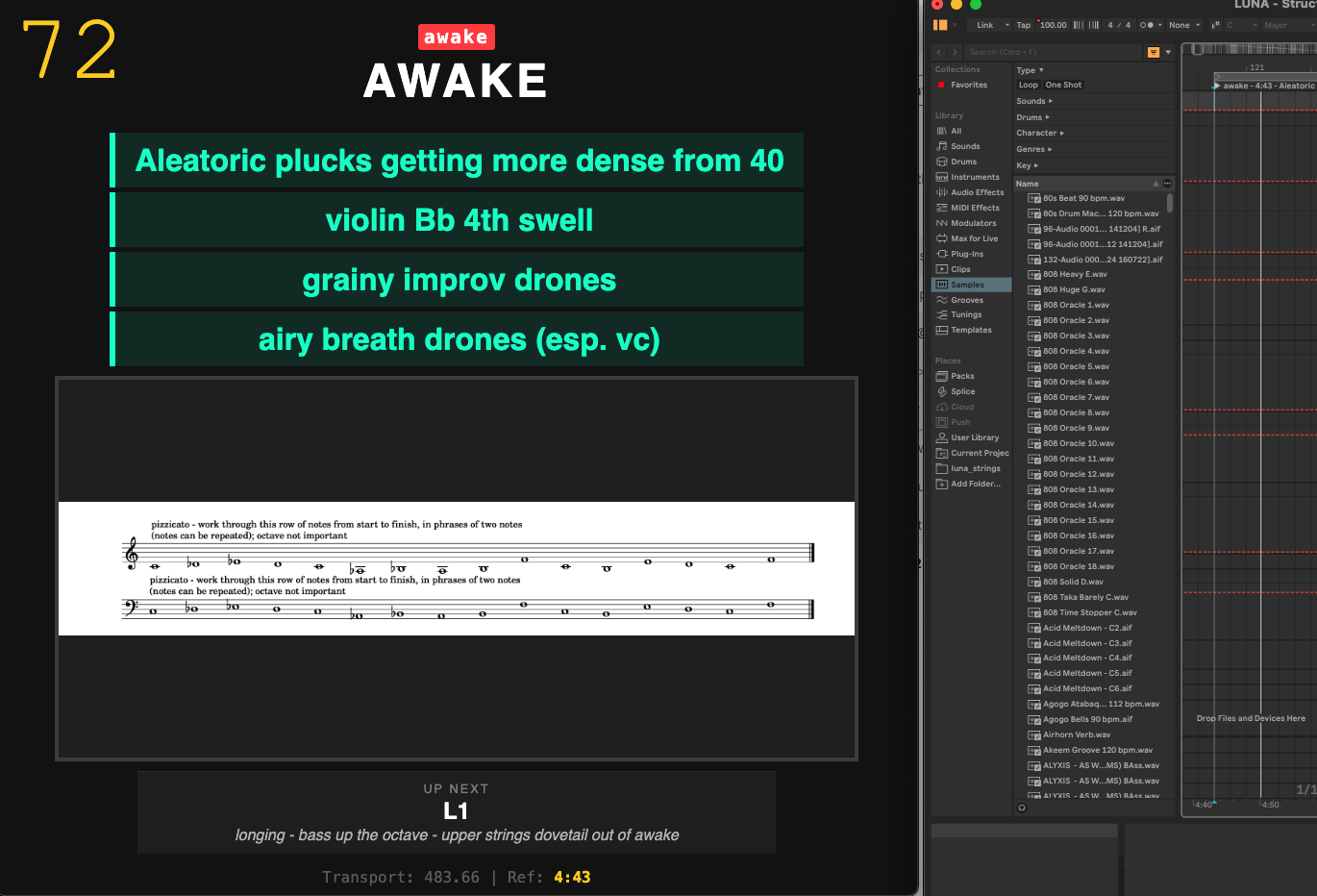
ableton-score
(2026)
system for syncing Ableton LIve and image-based music notation
ableton-score
(2026)system for syncing Ableton LIve and image-based music notation
Singing Hollow
(2025)
[240]
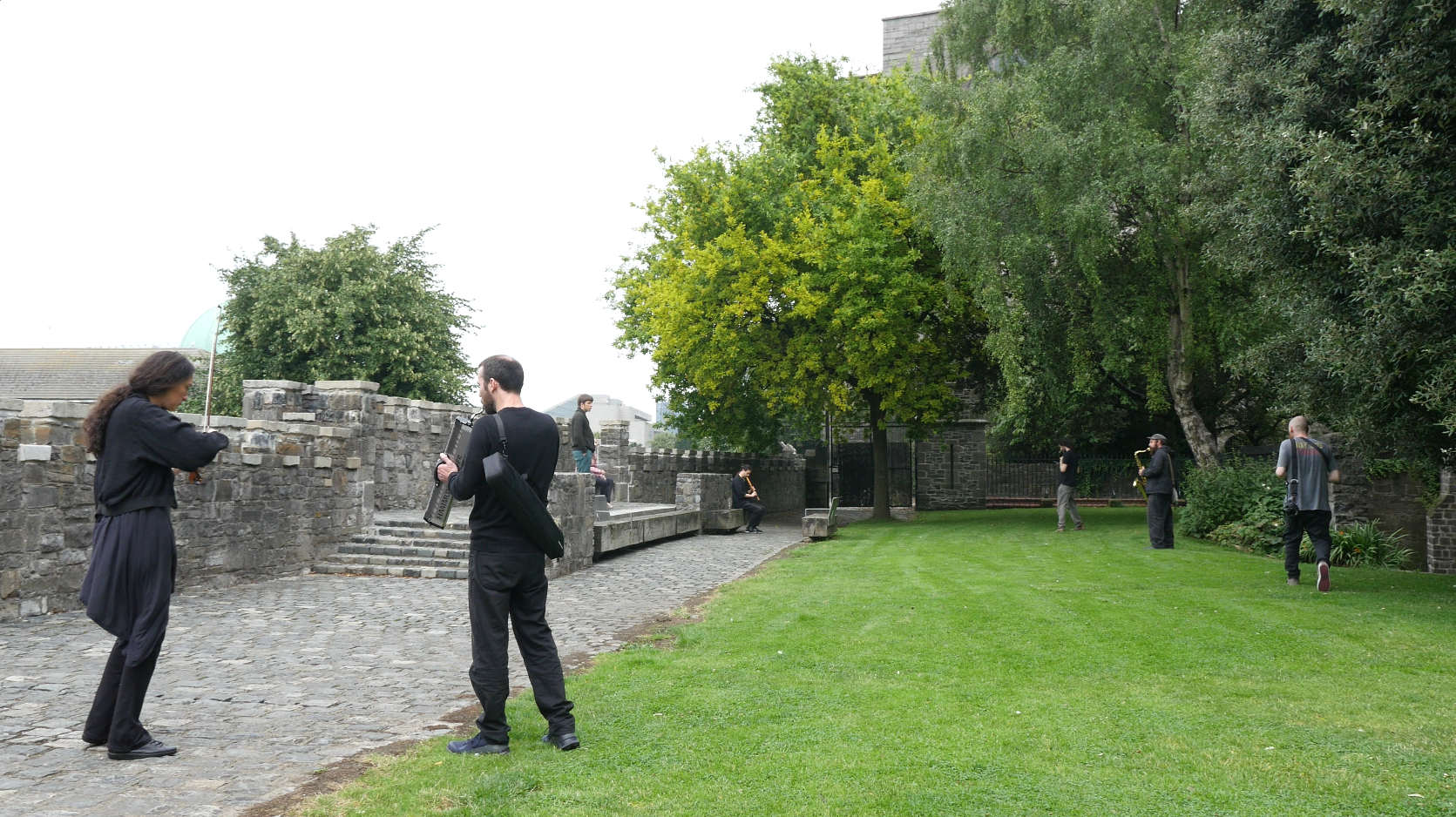
A performance installation for church bells (method ringers), organ, and walking instruments. Designed around St Audoen's Church, Dublin but adaptable to new spaces. Two computers required.
Singing Hollow
(2025) [240]A performance installation for church bells (method ringers), organ, and walking instruments. Designed around St Audoen's Church, Dublin but adaptable to new spaces. Two computers required.
The linked website includes documentation, a web-based score and much more detailed information about the piece.
The Singing Hollow sculpture in St Audoen's Park invites visitors to put their heads into a hole inside a rock. It creates an acoustic transformation reminiscent of the feeling of sanctuary from the outside world that comes when you walk into a church. This inspired this live sound installation: organ plays inside the church, musicians play in the grounds, and church bells bridge both worlds, all playing parts that are both independent and interdependent.
In the original performance, the piece is designed for four outdoor instruments, six church bells (each one rung by an individual) and an organ. It was specifically written for St Audoen’s Church of Ireland, which is an incredibly old church.
Commissioned by: The Office of Public Works and The Liberties Festival
[all] [chamber] [generative] [installation] [software] [improvisation] [gig] [web] [fluxusy]
web radio shuffler [test]
(2023)
browser-based web radio shuffle system (prototype)
web radio shuffler [test]
(2023)browser-based web radio shuffle system (prototype)
YouChoose
(2023)
a prototype for using superimposed YouTube videos as a live graphic score. never performed/finished!
YouChoose
(2023)a prototype for using superimposed YouTube videos as a live graphic score. never performed/finished!

Max Receive Finder
(2024)
software to assist with finding all receives or subpatches in a Max patch
Max Receive Finder
(2024)software to assist with finding all receives or subpatches in a Max patch
Solves a problem I found no ready-made solution for:
Finds all instances of r, receive and receive~ objects in a Max patch. This can be very useful if you are trying to document your patch, particularly if you communicate with receives using messages to Max. Can also help to troubleshoot redundant receives and inconsistent naming patterns.
To use, simply upload your patch and receive a list of all the receives in the patch
Or, as it's basically the same code, find all subpatchers in a patch
This software is licensed with The Unlicense and can be used freely. Max patches will be processed on your local machine and not uploaded to any servers.
ghost box
(2023)
generative website installation (with web radio)
ghost box
(2023)generative website installation (with web radio)
Inspired by an idea of Anaïs Fontanges, this is a web page that emulates ghost-hunting radio scanners as used by paranormal investigators. This idea sparked a period of fanatacism about radio and particularly about how the weird romance of the ephemerality radio somehow holds on even when you carry it into the digital domain (where the ephemerality is a little bit faked...)
It basically cycles randomly through a range of French and Irish web radio stations, with white noise faking a transition between stations! But sure the REAL ghost boxes are fakes too, aren't they....>>??????
Spotify Record Collection
(2024)
web app
Spotify Record Collection
(2024)web app
Not a piece, but a way to reproduce an old-fashioned record collection using Spotify.
I miss my old CD collection and also the alphabetical lists of albums/artists which helped me decide what I would like to listen to - rather than relying on the algorithm which seems to insist that Mitski is the same genre as every sad woman with a guitar
The record collection app lets you add albums to your collection. They are then added to a playlist on your Spotify account, but also displayed with the album art on the web app so you can see them all and remember what you might like to listen today.
I find it useful to help me remember what I used to listen to a long time ago, which is very difficult with anything algorithm-based.
The app works, but its not fast, and it's not pretty. Let me know if you're using it, I'd be really interested to hear what you think!
tHaasX
(2023)
generative web browser music
tHaasX
(2023)generative web browser music
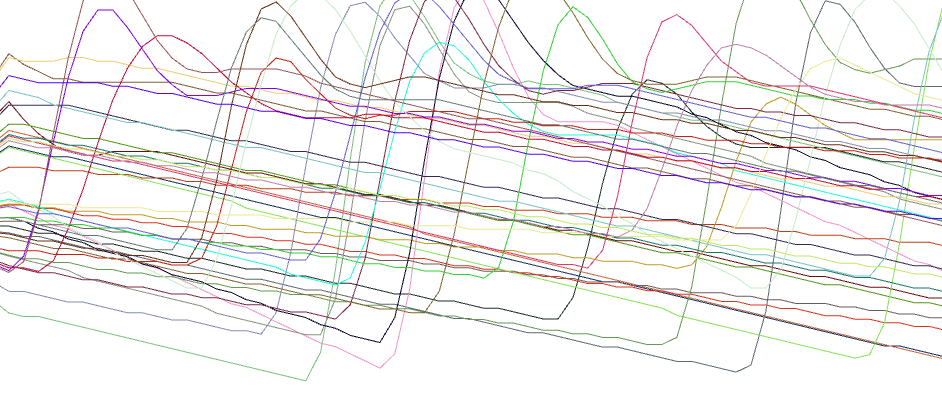
A generative implementation of the famous and amazing THX deep note, where random voices convene on a major chord. I added extra overtones to make it sound like a G.F. Haas piece. With a multi-dimensional oscilloscope to represent the sound in coloured lines. Unique each time you run it! Implemented using WebAudio (actually the first experiment I ever made with WebAudio, a couple of years ago), and animated using the built-in FFT analysis from WebAudio, coupled with HTML Canvas (just did this part yesterday). Because there are a huge number of oscillators + all the FFTs, it's quite heavy...so it sounds prettier on a computer. I'm sure it would be possible to make a much more efficient version but I was more interested in trying out the visualisation this week than optimising the audio code!
Try it a few times! You can also layer multiple renditions on top of one another, as long as the computer can handle it!
Graphical DMX Interface in Max MSP (for Kirkos)
(2022)
a lighting system using JSUI, DMX (Enttec device), Antela Smart Light integration, and a cue/preset system. All provided as-is, some bugs but potentially useful as a starting point. No longer using this at Kirkos.
Graphical DMX Interface in Max MSP (for Kirkos)
(2022)a lighting system using JSUI, DMX (Enttec device), Antela Smart Light integration, and a cue/preset system. All provided as-is, some bugs but potentially useful as a starting point. No longer using this at Kirkos.
Thought Music
(2022)
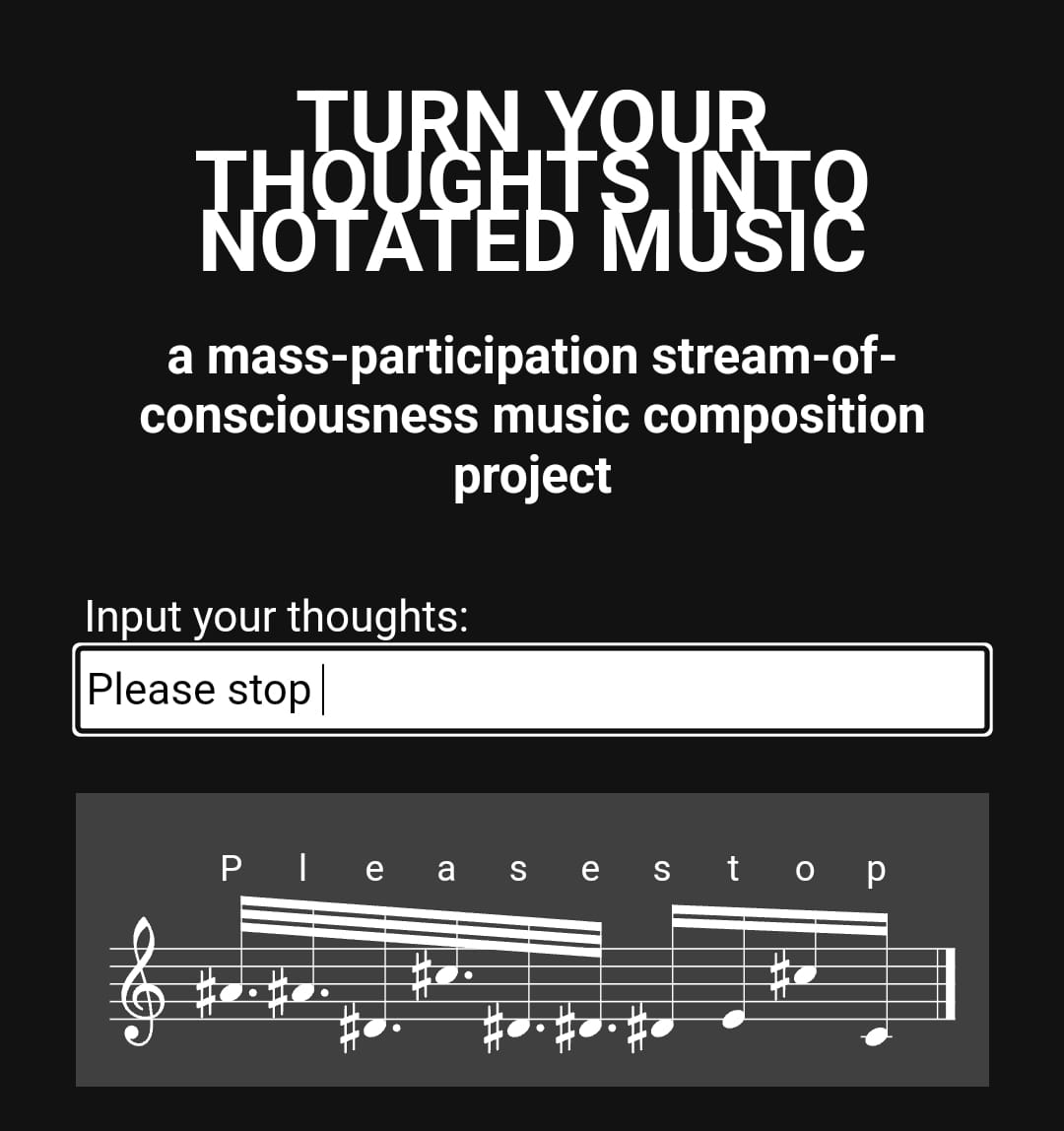
interactive web page (for use by anybody): text input converted into music and can be played back and saved to a database
Thought Music
(2022)interactive web page (for use by anybody): text input converted into music and can be played back and saved to a database
timetravel webradio
(2023)
web installation (playback of web radio)
timetravel webradio
(2023)web installation (playback of web radio)
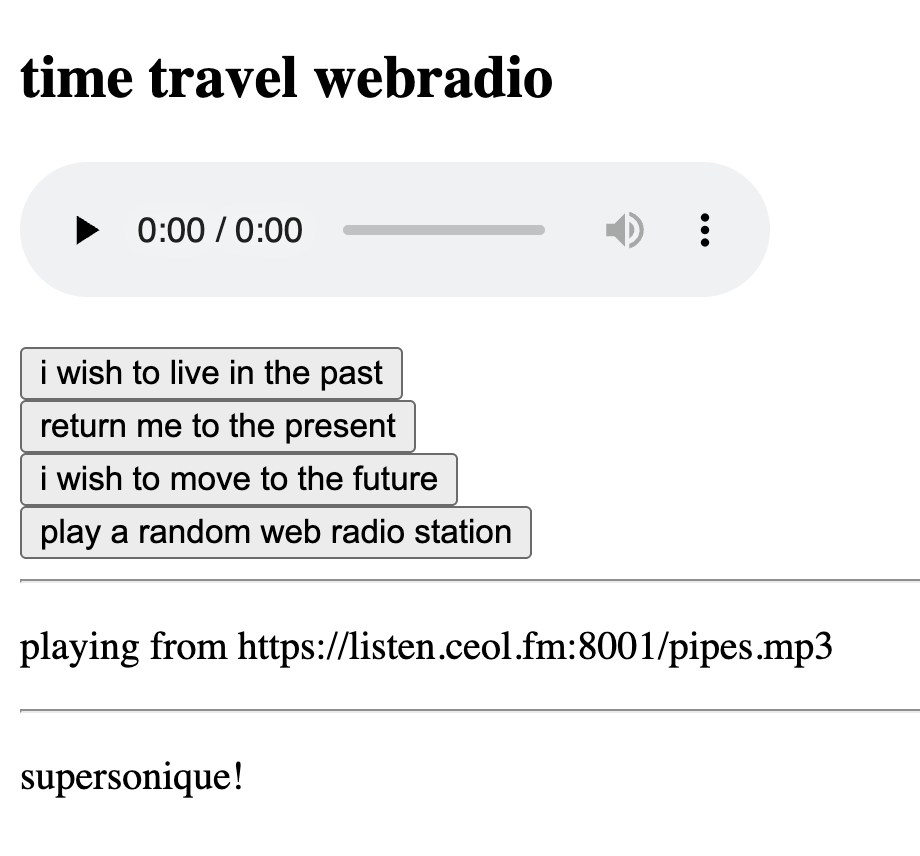
A huge selection of digital radio stations from Ireland and France are randomised, and you can go back in time (by playing them slower: the longer you listen to it like this, the further away you are from the real-time radio stream) or forwards in time: unlike a real radio station, digital radio often relies on file streams - so even when something hasn't happened yet you can often fast-forward through them.
Deciphering
(2018)
generative notation system, seven performers
Deciphering
(2018)generative notation system, seven performers
Workings from Work for Harpsichord
(2014)
generative notation system, three performers
Workings from Work for Harpsichord
(2014)generative notation system, three performers